
Scene from office space movie. The "two Bobs" interrogate Tom: "what would you say you do here?"

The End of the Product Manager (As We Knew It)

There’s a scene in Office Space where two consultants, the infamous “Two Bobs,” ask Tom Smykowski a deceptively simple question: what would you say you do here? Tom bristles. He explains that he talks to customers, translates between teams, and keeps things from falling apart. “I have people skills,” he says, and still fails the interview. Initech is bloated, inefficient, and badly run; the Two Bobs are there to reduce headcount, strip out bureaucracy, and show quick savings. But their logic only worked because technology and process standardization were already absorbing coordination and oversight work. What once required multiple roles could now be combined, or eliminated.

The film predates the economic shifts now underway with generative AI, but the pattern is familiar. As tools become more capable, work that once required multiple specialized roles begins to recombine. The work itself isn’t disappearing, but the categories we use to describe it are breaking down as responsibilities coalesce. Product management isn’t going away; it’s becoming more demanding and more technical. As AI tools absorb coordination and translation work, product managers are increasingly responsible for judgment, ethical tradeoffs, and hands-on experimentation. The historical boundary between defining software and building is collapsing—and product managers are increasingly expected to operate on both sides of that line.

For more than a decade, I worked in international democracy and civic technology programs at the National Democratic Institute, where product work rarely looked like Silicon Valley product management. Budgets were tight, users were diverse, failure carried political and reputational consequences, and technology had to function inside institutions that moved slowly and had low risk tolerance. I was often cast as “the people person,” responsible for translating between program teams, technical constraints, and real-world use. I served as product manager for the DemTools suite—a set of open-source tools NDI hosted and maintained as a shared service for civil society and political actors—defining roadmaps and requirements, managing vendors, and taking responsibility for whether tools actually worked in practice, not just in theory. This was product management in the classical sense, shaped by the realities of international development and democracy support.

While my perspective is grounded in the international development, non-profit and government sectors, the consolidation of product roles is equally applicable to the for-profit and tech industries. Indeed, tech-sector product managers are likely the vanguard in this trend, being among the first to face the need for deeper technical capabilities as AI tools mature.

When the Trump Administration abruptly ended most foreign assistance, I was laid off, along with many others in my sector. That moment forced a reevaluation of my value in the job market—which kinds of work remained in-demand as institutions retrenched. It also created space. For the first time, I could spend sustained time working directly with tools now accelerating this consolidation. At NDI, I had been invited into an internal AI working group, but hands‑on use of contemporary AI coding tools was largely prohibited in day‑to‑day work. Outside those constraints, the shift was clear: even without formal computer science training, these tools have allowed me to expand what product management itself entails. And this experience reflects a broader market trend: as software development becomes more accessible, roles consolidate, and product managers are increasingly expected to build, not just define, the tools they own.

Building Without a Buffer

After my layoff, I began experimenting seriously with AI‑assisted coding tools to solve problems I had previously only managed indirectly. Working inside an integrated development environment (IDE)—the software workspace where code is written, run, and debugged—with a coding agent that can read my codebase, refactor logic, and respond to tightly scoped instructions, I was able to move from defining requirements to implementing and testing them myself. 

I took on work I had previously only specified or reviewed: writing data-cleaning scripts to normalize inconsistent datasets; building small backend services and database schemas; wiring together APIs, authentication, and basic front-end components; and deploying a functioning open-source web application. Work that once required contracts, budgets, and months of coordination now happens in days. As a result, I spend less time coordinating handoffs and more time interrogating outputs—testing assumptions, pressure-testing model behavior against real-world constraints, and deciding where automation ends and responsibility begins. That experience has given me a clearer sense of how to embed institutional policies into practical system behavior: shaping product direction, advising teams on appropriate uses of AI, and setting guardrails that organizations can actually stand behind.

AI hasn’t turned me into a senior engineer, and I wouldn’t ship production‑level code without review. But it has allowed me to turn conceptual understanding into working systems while retaining responsibility for product decisions. At the same time, these tools hollow out traditional entry points on the engineering side. Junior‑level work—boilerplate, scaffolding, translation between systems—is increasingly easy to automate. The developer, product manager, and project manager roles aren’t vanishing; rather they’re collapsing inward, concentrating responsibility in fewer hands.

A Failure That Taught Me More Than the Wins

My first serious attempt to build something more ambitious—an Easy Read generator tool—failed for a number of reasons. First, I started with a product mistake. Instead of defining clear, minimal functional requirements and testing a narrow MVP, I tried to build everything I thought the tool eventually needed to be. I collapsed “prototype” and “platform” into the same effort before validating the core idea.

That mistake collided with a harder constraint. I ran into a real technical limit: current AI tools are still extremely weak at generating Easy Read–style images that actually support reading comprehension for people with intellectual disabilities. The requirement exceeded what the technology can responsibly deliver today—and it also exceeded my abilities as a solo developer. Closing that gap would have required orders of magnitude more time and effort, up to and including training a custom image-generation model—well beyond the practical scope for this project.

The failure wasn’t just technical; it was conceptual. Building directly with AI tools made that misalignment impossible to ignore. There was no vendor buffer and no sprint cycle to hide behind—the system simply stopped cooperating. When you work this close to implementation, bad assumptions fail immediately. Either the requirement was flawed, or I lacked the technical depth to solve it. In this case, it was both.

Human Connection Still Matters

As roles collapse and responsibilities concentrate, human collaboration becomes even more critical. In my own work, this has taken a few concrete forms: regular collaboration with former colleagues who are practicing software developers, and reaching out to others working on similar problems. Sometimes this looks like show-and-tell; other times it takes the form of short, informal working sessions to compare approaches. The emphasis isn’t on tools for their own sake. It’s on clarifying what we’re actually trying to build, catching weak assumptions early, deciding what not to attempt, and making sense of rapidly changing technology together.

Those interactions do work that AI tools don’t. Coding agents accelerate implementation, but they don’t independently challenge framing, surface blind spots, or carry context across decisions. When you’re simultaneously acting as developer, product manager, and project manager, peer-level human feedback becomes the primary check on overconfidence and misjudgment. AI may compress roles, but it also reduces opportunities for feedback. As those feedback loops shrink, collaboration has to become more intentional. Without it, the risk is the accumulation of unrecognized mistakes—problems you don’t realize you’re creating until they surface downstream.

Conclusion (As We Know It)

When I talk about the end of the product manager, I’m not predicting the disappearance of a job title. I’m describing the collapse of a boundary. As tools change the economics of building, the old division of labor—between defining work and implementing it—no longer holds. What’s ending isn’t product work itself, but the idea that it can remain insulated from the act of building.

AI-assisted coding compresses the distance between intent and execution. Product managers who can’t get close to the code risk losing contact with reality; developers who can’t reason about requirements inherit decisions they didn’t make. Responsibility concentrates, feedback loops shrink, and mistakes surface later without intentional human collaboration.

This isn’t a story about replacing expertise or celebrating lone builders. The tools only work when grounded in real technical understanding—and they fail fast when that foundation is missing. What changes is who is expected to carry that understanding, and how early.

The end of the product manager isn’t the end of product work. It’s the end of pretending that thinking and building can be cleanly separated. What comes next belongs to people willing to hold both sides of that responsibility at once.

AI Without Women Is a Risk: A Benchmark for Peace and Security

By Jesper Frant and Moira Whelan

Generative AI models are rapidly finding a place in high-stakes decision-making—from drafting policy briefs to analyzing threats and coordinating humanitarian relief. Yet these systems often carry baked-in blind spots when their training data and evaluation frameworks inadvertently encode societal biases or disproportionately underrepresent perspectives from women, resulting in skewed outputs and meaningfully disparate accuracy across groups. Such blind spots can undermine human security, inhibit crisis response and prevent sustainable peace, all through the inadvertent marginalization of half the population.

Gender inclusion leads to more durable security outcomes. Studies show that peace agreements with women’s participation are 35% more likely to last at least 15 yearsUN Security Council Resolution 1325 represented the global recognition that women’s meaningful participation is crucial for effective peace processes, resilient communities, and inclusive governance. Despite this evidence, research that does not factor in the unique experiences and perspectives of men and women still dominates the security space. Therefore, the data sets that inform new AI tools have an inherent blind spot that will prevent applications from being as effective as they can be to help users achieve security outcomes.  To overcome this barrier, researchers have developed bias benchmarks to measure model performance, inform users, and enable engineers to build more effective products. A benchmark is a curated suite of tasks and quantitative metrics—often in the form of targeted prompts and scenario‑based probes—designed to systematically evaluate how well an AI model handles a specific domain or capability. However, most existing benchmarks focus on generic or decontextualized tasks and fail to capture the complex, multilingual, and intersectional scenarios inherent in conflict situations.

A dedicated Women, Peace and Security (WPS) specific benchmark would have multiple benefits. First, it would spotlight how large language models (LLMs) perform in real-world peace and security contexts: from ceasefire negotiations and refugee protection planning to counter-extremism communication in local languages. By evaluating models against scenario-based probes that reflect the nuances of WPS, we can give model developers clear performance goals to aim for in WPS scenarios. Second, it will also give us a standardized tool to evaluate mitigation approaches, such as enhanced prompting strategies, RAG (retrieval-augmented generation), fine-tuning with curated WPS datasets, or deploying domain-specific “constitutions” of guiding principles. Third, it would create a clear blueprint for similar, domain‑focused benchmarks across the human security space—so that whether it’s health crises, climate resilience, or atrocity prevention, we have a repeatable model for evaluating the use of AI tools where the stakes are highest. 

We hope that publishing WPS benchmark results can incentivize companies to embed human security considerations into their training pipelines – improving model outputs while mitigating risk for AI companies. In this way, benchmarks act as a feedback mechanism, translating WPS needs into concrete metrics that guide continuous model improvement and ensure AI tools support more effective and durable peace and security interventions.

The Limits of Today’s Bias Benchmarks

Overreliance on Generalized Tasks: Most bias benchmarks—StereoSetCrowS-PairsGenderBench, and the like—operate on broad, decontextualized language tasks. A sentence about a doctor or a nurse, a fill-in-the-blank prompt about athletes or artists. None of these directly mirror the nuance of a peace negotiation, a humanitarian assessment, or a violent extremism counter-messaging campaign. More generalized benchmarks may miss how an LLM behaves in high-stress conflict scenarios. 

Overlooking Intersectionality and Language Diversity: Bias often intensifies when identities overlap, precisely the same contexts in which conflict also intensifies. Most multilingual bias studies focus on English and a handful of major languages, and rarely consider regional, ethnic or linguistic identity, let alone gender dynamics within that. LLMs, with their vast neural nets and probabilistic outputs, generate different answers based on different contexts. Benchmarks that fail to examine how models behave under diverse intersectional and linguistic contexts risk missing critical areas of model bias. Context risks such as these in an LLM certainly will weaken models, but as models and benchmarks are developed, they will need to be continuously refined to address these overlaps. 

Failing to Address Cognitive Bias in High-Stakes Contexts: Bias benchmarks have exposed how models can replicate ingrained patterns of human thinking—status quo bias, in-group favoritism, confirmation bias. Yet they stop short of testing these biases in WPS scenarios. Can we trust a model to flag risks to peacekeepers, or defaulting to the typical needs or priorities of only half the population? Without such context-rich probes, we risk that decision-makers in national security agencies or disaster relief organizations using these tools will fail to factor in these real and consequential blind spots.

Disconnect Between Audits and Incentives: Finally, many bias evaluations remain academic exercises. They measure gaps but rarely feed back into model development or procurement processes. There are currently no standard requirements for companies to run specialized WPS tests, and donors or end-users lack common criteria to request them. The result? A gulf between what we know about bias and what gets fixed in practice.

These limitations don’t mean existing benchmarks lack value. Rather, they highlight the need for complementary tools. A WPS benchmark builds on them by applying similar tools to high-risk, underrepresented domains that are often ignored in mainstream evaluation.

How a Benchmark Can Drive Change

Building a WPS-specific benchmark is more than an academic exercise. It’s a lever to shift incentives across the AI ecosystem:

Shaping Model Development Priorities: By publishing a transparent suite of WPS probes—scenario-based vignettes, peace dialogue counterfactuals, multilingual intersectional templates—we create a clear roadmap for where models fall short. AI designers seeking market credibility will be incentivized to report their performance against these tests, just as they currently tout benchmarks like GLUE or SQuAD because they carry credibility from a community of experts.

Empowering Donors and Regulators: International donors and governments already require ethics checklists and technical standards. A WPS benchmark can be a practical compliance tool: funders can condition grants on passing core bias thresholds. Regulators exploring AI safeguards can reference the suite as an example of domain-tailored fairness metrics, reinforcing accountability.

Guiding Academic Partnerships: Research labs thrive on open challenges. A public WPS benchmark invites universities and think tanks to iterate on bias mitigation—whether through expanded pre-training datasets, targeted fine-tuning, adversarial data augmentation, or novel Reinforcement Learning with Human Feedback (RLHF) protocols. Collaborative leaderboard efforts can spotlight the highest-performing approaches, accelerating progress.

Elevating Civil Society’s Voice: By documenting AI bias in conflict and humanitarian contexts, we arm local NGOs, women’s rights groups, and peacebuilders with evidence. They can pinpoint how off-the-shelf AI tools perform in these high-risk scenarios, and advocate for tailored solutions that reflect their lived realities.

Closing the Loop: Crucially, a WPS benchmark isn’t a one-off test. It’s a continuous monitoring framework. Each model update invites re-evaluation: did cognitive-bias tuning reduce status quo bias in negotiation prompts? Did multilingual debiasing improve representation of diverse linguistic and cultural perspectives? This iterative loop ensures that WPS needs remain front and center in model development roadmaps.

Why Hasn’t This Been Done Yet? 

Until very recently, civil‑society tech efforts have focused almost exclusively on content moderation and online harms—areas that attract far more attention (and funding) from both governments and the private sector. Meanwhile, budgets for gender‑focused AI research have contracted, leaving a gap between policy commitments and technical practice. As a result, despite progress made to bake them into security and humanitarian frameworks, they’ve yet to meaningfully influence how AI tools are designed and evaluated.

Looking Ahead

A WPS benchmark won’t solve model bias overnight—but it will serve as a critical foundation linking rigorous research to real-world impact. By embedding domain-specific probes into AI evaluation pipelines, we can ensure models perform reliably in high-stakes peace and security contexts. Multilingual and intersectional case studies will catch harms that disproportionately affect women across ethnic, linguistic, and regional lines. This benchmark will not just expose bias, it will highlight practical, grounded, and evidence-backed strategies for mitigating bias—especially in high-stakes domains like peace and security—that can immediately be put into practice. This will empower funders, developers, governments and civil society to demand better AI and make better use of current systems. Over time, this feedback loop will help AI tools reinforce, rather than erase, women’s leadership in peacebuilding. 

The ripple effects will reach far beyond WPS, driving progress across adjacent domains—from responsive design to equitable healthcare and economic justice. The overarching goal of creating a benchmark is to overcome the blind spots that have long undermined peace and security decision making. By improving how emerging technologies handle these contexts, we can ensure AI doesn’t just accelerate decisions—it helps lead to safer, more inclusive, and more durable outcomes.

Editor’s Note: The WPS AI Benchmark Project is run by Our Secure Future with an intention of designing with and for the WPS Community. 

This story was originally posted on oursecurefuture.org.

Three people in hats and rubber boots navigate a muddy tidal mangrove forest in Bahía Málaga, Colombia, balancing on a dense labyrinth of exposed aerial roots beneath a canopy of slender tree trunks.

Imagining International Development in A Multipolar World

“We are going to have a multi-polar sustainable development world. It’s not going to be led perhaps by the United States or by some of the traditional actors.”

That’s how Jeffrey Sachs reflects, in his recent video, on the sudden collapse of many U.S.-funded development programs and the broader geopolitical realignment underway. But how will that realignment play out in practice for international development?

Sachs points to large-scale regional initiatives like the African Continental Free Trade Area (AfCFTA), which unites 55 countries around shared economic goals. He sees momentum building across Southeast Asia, the Middle East, and Latin America. He also praises China’s Belt and Road Initiative (BRI), an ambitious effort to link infrastructure and investment projects across continents.

While Sachs “admires” the BRI, I view it with more caution. The initiative has undoubtedly reshaped global development finance—but often at the cost of saddling countries with unsustainable debt, locking them into opaque agreements, and emphasizing extractive infrastructure over inclusive, community-driven growth. Development that mortgages the future in service of the present is not development worth celebrating.

Still, Sachs is right about the bigger picture. Even as initiatives like the BRI draw critique, they exemplify a broader shift: the world is no longer waiting for traditional donors to lead. Sachs’ observation reflects not only a change in geopolitical dynamics, but also a loosening of the development script—one no longer authored exclusively by the familiar cast of Western donors and Bretton Woods institutions. Countries are forging new alliances, testing new platforms, and imagining new paradigms.

The landscape for non-state international development finance is also shifting. A vital but often overlooked source of development finance is remittances—money sent home by migrants and diaspora communities. I wrote my undergraduate thesis on the potential of the “migrant transnational class” to drive rural development through remittances and social capital, focusing on return migration in Mexico. That research explored how remittances improve livelihoods, fund education, and support local businesses—not just as financial transfers, but as part of a broader ecosystem of transnational engagement. In many regions, they have long outstripped foreign aid in both volume and impact.

That lifeline is now under threat, at least for U.S.-based remitters. As part of the Trump administration’s “One Big, Beautiful Bill,” the U.S. government has proposed a new federal tax on all remittances sent abroad—effectively taxing migrant families twice. In 2024 alone, sub-Saharan Africa received nearly $10 billion in remittances from the U.S.—a figure nearly on par with the total foreign assistance it received before the Trump-era cuts. Countries like Gambia, Liberia, and Senegal, where remittances make up a significant portion of national income, would be especially hard hit (New York Times, June 3, 2025).

Another notable trend is the growing influence of private wealth in shaping the development agenda. States and multilateral institutions have historically dominated this space. While a few large philanthropies—most notably the Bill and Melinda Gates Foundation—have had outsized impact in areas like global health, their overall scale has not yet matched that of state-backed finance.

But that balance may be shifting. As private fortunes—particularly those built in the tech sector—continue to grow, a new class of philanthropic actors is emerging. This trend is likely to accelerate as a handful of major companies consolidate control over the development of frontier Generative AI models, further concentrating global wealth and influence in an already narrow segment of society. This concentration not only shapes who builds the tools of the future—but also who sets the ethical guardrails and development priorities surrounding them. Some, like those aligned with Founders Pledge, are optimistic that tech entrepreneurs can become a transformative force in global development. As the organization puts it: “In our vision of the future, the value created by technology benefits those who need it most.”

Yet not all tech billionaires are channeling their influence in support of international development. Elon Musk, despite being the world’s richest individual, was a driving force behind blanket cuts to U.S. foreign aid—a stark reminder that private wealth is not inherently aligned with global development goals.

While private capital can certainly catalyze innovation, it also risks entrenching the very power imbalances development is meant to dismantle. And unlike centralized agencies such as USAID—which, for all their flaws, offer unified leadership, institutional memory, and a coherent development philosophy—philanthropic giving led by individuals is inherently more fragmented. Its goals, methods, and ideologies vary widely from donor to donor, making it harder to ensure consistent priorities or align efforts across sectors and regions.

In short, development finance in a multipolar world will be messy. With power dispersed across regional blocs, diaspora networks, corporate actors, and tech philanthropists—each with competing priorities and asymmetrical resources—the international development landscape is becoming less hierarchical and more contested. This pluralism presents both opportunities and risks. It opens the door to more locally rooted, innovative approaches, but also raises the specter of incoherence, duplication, and unaccountable influence.

As we enter this new era, goals, methods, and ideologies will continue to diverge—mirroring the broader dispersion of influence in the global order. The challenge will be to embrace this multiplicity without losing sight of shared values, and to cultivate mechanisms that enable alignment when necessary, while leaving space for difference and disruption where it matters most.

Why “Secondhand Worlds”?

I named this blog after a line from C. Wright Mills’ 1960 essay The Cultural Apparatus, which I first read in 2008 during a journalism school class at the University of Colorado:

“The first rule for understanding the human condition is that men live in second-hand worlds. They are aware of much more than they have personally experienced; and their own experience is always indirect. The quality of their lives is determined by meanings they have received from others.”

That quote has stayed with me—not just because it’s a sharp observation about how we process the world, but because it remains unsettlingly relevant. We don’t encounter reality raw; we inherit it through headlines, feeds, photos, slogans, and the countless interpretations of others. Mills called the system that produces and distributes these interpretations the “cultural apparatus.”

Back in 2008, journalism as a profession was entering a crisis that has only deepened since. The demise of local newspapers and public-interest reporting, the erosion of journalistic ethics, the rise of social media, the fragmentation of the internet, and now the explosion of AI and synthetic media—seen through the lens of C. Wright Mills, these shifts help explain much about our current moment. The cultural apparatus isn’t just evolving; it’s fragmenting, accelerating, and becoming harder to trace and trust.

Today, that apparatus is both more expansive and more manipulable than Mills could have imagined. Platforms like TikTok, YouTube, and X (formerly Twitter) deliver curated slices of experience in real time. AI-generated content blurs the line between authentic and synthetic, while billionaires, governments, and opaque algorithms shape what rises to the top. Conspiracies scale faster than facts. The experience of “seeing it with your own eyes” is often preempted by a push notification or a viral meme.

In this environment, the question isn’t whether we live in secondhand worlds—it’s who’s furnishing them, and to what end.

That’s why I started this blog. Over the years, I’ve used this space to explore those questions directly—writing about civic tech, participatory democracy, communication systems, and the ethical design of digital tools—all efforts to interrogate and influence the cultural apparatus itself. It’s a place for me to think critically about the cultural apparatus we all live within—and to make my own small contribution to it. I’ve worked in digital communications, civic tech, and democracy support. I’ve seen how narratives can be built for liberation, and how they can be weaponized. I’ve tried to help build tools and spaces that make democratic values legible, accessible, and resilient.

If we’re going to live in secondhand worlds, then let’s at least try to make them better ones—rooted in equity, truth, and human dignity.

A young green seedling with two oval cotyledons and two small serrated leaves emerging from dark, moist soil.

My Soft Career Pivot: Global Programs to Domestic Impact

After ten years at the National Democratic Institute — in roles ranging from digital communications to project management — I was laid off. Like many others in the international development space, I was swept up in the collapse that followed the Trump administration’s elimination of U.S. foreign assistance — a move that also gutted the very institutions meant to support democratic resilience abroad.

For me, this marked the end of a decade at the National Democratic Institute. Over ten years, I served in a range of roles — from digital communications to project management — and spent the last several years as part of NDI’s DemTech team. While I wasn’t formally a team lead, I often played a leadership role in practice, especially when it came to managing complex tech implementations and coordinating with external vendors. I helped define requirements, translate between program needs and technical delivery, and make sure tools actually worked for the people using them.

That kind of continuity is rare in this field — and it has made reentering the job market unexpectedly disorienting. It meant that when the layoff came, I had been thrust into a job market I hadn’t needed to navigate in a long time. My muscle memory was gone. The terrain had changed. And so had the sector. I found myself questioning how my experience would translate to other contexts — whether a decade of work in international democracy programs, with their specific jargon and frameworks, would resonate with new employers or sectors outside that bubble. Is what I’d built still relevant — and valuable — to others?

While the sector begins to innovate and rebuild, another tsunami is underway.

The AI wave is still swelling — reshaping workflows, disrupting institutions, and raising profound questions across education, journalism, policy, and governance. Tools like ChatGPT and open-source LLMs aren’t just new technologies; they’re catalysts for rethinking how knowledge, communication, and power are structured. This future is unfolding faster than most civic institutions can respond. And the pace of deployment continues to outstrip our collective ability to govern or understand it. As someone who’s worked at the intersection of tech and democracy, I see how the rush toward AGI and rapid productization is leading many companies to underappreciate the human impacts of these tools. The people most affected — especially those already underserved — are often left out of the design process entirely. We need to re-center human consequences in this work, not treat them as edge cases or cleanup tasks.

At least in the short term, the U.S.-funded international development sector won’t bounce back. (I’ve even suggested to the director of my graduate program — Columbia SIPA’s MPA in Development Practice — that it could help reimagine what this future might look like.) So I decided to start building something different — a new way of working that still aligns with my long-term goals.

I began working as a freelance consultant. Not just as a placeholder, but as a way to work more intentionally, partnering with organizations I respect to build tools and strategies that fit this moment. Much of that work has been with domestic clients — a shift I didn’t plan, but one that’s opened new ways to apply my skills in deeply local, relevant ways. The challenges are different, but the core questions remain: who is this for, and who’s being left out?

And while “consultant” is a new title for me, the work itself isn’t unfamiliar. In fact, it feels like a natural extension of what I was already doing — just with new labels and new audiences.

In fact, much of what I’m doing now builds directly on my experience in NDI’s DemTech team, where I was often brought in midstream to help shape, fix, or redesign technology projects in motion. The teams I supported spanned regions, mandates, and technical comfort levels. I learned to enter fast, listen carefully, clarify goals, and help make messy projects functional and sustainable. That experience made me unusually comfortable with the core conditions of consulting: ambiguity, velocity, and cross-functional collaboration.

And before that, in grad school, I had dipped into consulting too — primarily building websites. It was project-based, creative, and real-world — and I loved it.

This isn’t just about helping teams with tech. It’s about helping organizations stay grounded in their values while adapting to real-world constraints — shrinking budgets, shifting priorities, and powerful new tools that are easy to misuse or misunderstand.

At the same time, I won’t pretend consulting is a guaranteed path. It’s fulfilling, but it’s also uncertain. I’m constantly juggling multiple projects, working pro bono, staying open to new collaborations, and — like many others in this space — always thinking about what’s next. For now, it’s a path I’m walking with intention — even if I don’t have all the answers yet. I’m still figuring out what this looks like long-term, and how best to align the work I care about with the evolving needs of the field. At some point, that may require a harder pivot — one that stretches beyond adjacent spaces and demands a deeper reinvention. If and when that time comes, I hope to meet it with the same clarity of purpose. In the meantime, I continue to explore full-time opportunities that align with this mission and allow me to do this work in a more sustained, strategic way.

Choosing the Right Contact Management System: From spreadsheets to CRMs

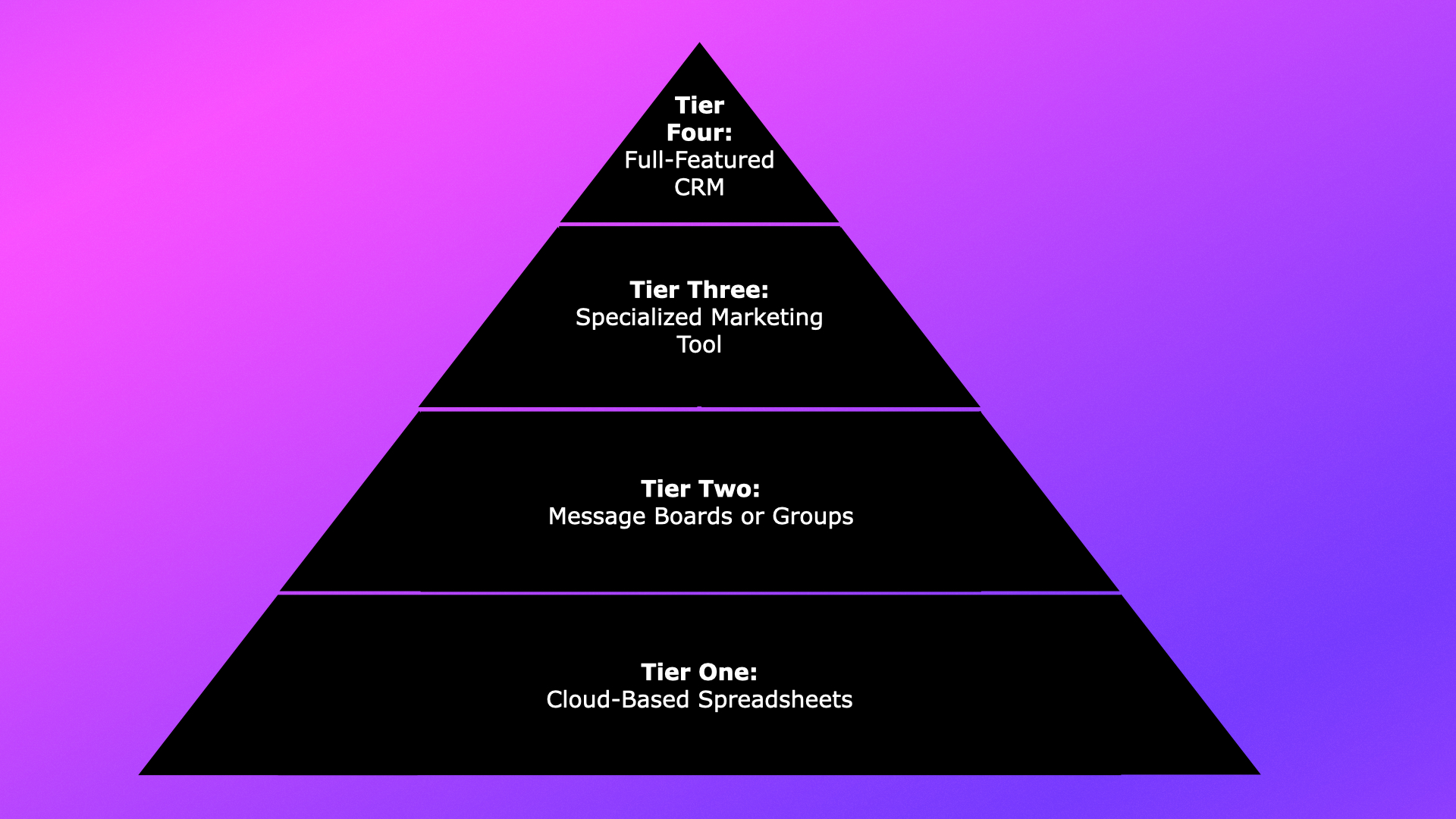
Pyramid chart depicting four tiers of contact management tools.

Editor’s Note: If you like this blog, you’ll like How DemTech Supports Digital Organizing Around the World.

Managing and organizing contact information is a vital task for any organization, and it can be a rewarding challenge. Whether you’re a political party managing membership lists or an advocacy group organizing campaigns, maintaining lists of contacts, tracking interactions, and conducting outreach are essential activities that can drive your mission forward. In particular, moving from a siloed approach – individual staff are responsible for their own contacts – to teams – collaborating on a shared online database – can pay huge dividends. 

The array of available cloud-based databases is vast, but every organization has different sets of needs, levels of expertise, and financial resources that will determine the right tool for the context. This blog post aims to provide essential guidance to help you identify the perfect cloud-based database tool to meet your goals and technical requirements, turning this challenge into an opportunity for growth and efficiency.

Different Tiers of Contact Management Tools

Contact management tools range from simple spreadsheets to feature-rich contact relationship management systems (CRMs). We’ve broken down these tools into four tiers based on complexity and specialization. By understanding the capabilities and limitations of each tier, you can choose the contact management tool that best fits your project’s needs and resources. The examples below are not exhaustive and were chosen to illustrate solutions that are available at little or no direct cost. Generally, as the tools become more complex, they tend to become more expensive.

Tier One: Cloud-Based Spreadsheets

Example: Google Sheets is a versatile and accessible tool for basic contact management. It allows users to create, share, and collaborate on spreadsheets in real-time. With features like data validation, conditional formatting, and integration with other Google Workspace apps, it’s a great starting point for small teams or projects with straightforward needs.

Tier Two: Message Boards or Groups

Example: Google Groups focuses on communication and collaboration rather than just contact management. It allows you to create and manage groups of contacts for email communication and collaboration. Unlike most other systems, it allows members to speak with each other, and it is ideal for multi-stream communication. While it doesn’t offer the advanced contact management features of a CRM or the flexibility of a spreadsheet, it provides a simple way to communicate with and manage groups of people, making it a great fit for teams or projects that need a straightforward collaboration tool.

Tier Three: Specialized Marketing Tool

Example: MailChimp is a specialized marketing tool designed for email marketing and constituent engagement. It offers features like automated email campaigns, audience segmentation, and detailed analytics. MailChimp is ideal for organizations looking to enhance their marketing efforts without the complexity of a full CRM system.

Tier Four: Full-Featured CRM

Example: CiviCRM is a comprehensive CRM platform that supports extensive contact management, communication, event management, casework, and campaign planning. It allows users to store, track, and segment large volumes of contact data, and engage with contacts via email, SMS, and social media. CiviCRM is suitable for organizations that need robust features for managing relationships and coordinating large-scale activities. DemTech supports the use of CiviCRM through its DemCloud hosting service, providing a cost-effective solution for partners with limited resources, though organizations will need to dedicate significant staff time to make the most of using this tool.

Selecting the Right Tool for Your Needs

Step One: Define Your Requirements

Start by clearly defining what you need from the tool. Your key needs will depend on the problem you’re trying to address and may include:

Language Requirements: Does the tool need to support multiple languages?

Offline Capability: Will you need to access the tool without an internet connection?

Security Requirements: How critical is data privacy and security for your project?

Specific Features: Do you need features like email marketing, customer segmentation, case management, or detailed analytics?

Step Two: Prioritize Your Requirements

Once you’ve defined your requirements, prioritize them. Use a Human-Centered Design (HCD) process to ensure that the tool meets the needs of your users. Always consider the context in which the tool will be used. In addition to the functional requirements (the features of the tool), you should also consider your organization’s needs and assets with regard to privacy, capacity, and sustainability.

Privacy: Since contact management systems inherently manage information about individuals, privacy should always be a priority. Consider your risk profile in determining the steps you need to take to ensure the security of the information you are collecting.

Capacity: Assess whether you and your target audience have the skills, resources, and availability to use the technology as intended. Consider how technology gaps might reinforce the exclusion of marginalized populations.

Sustainability: Determine if you will need to use the tool long-term. Do you have the ability to sustain funding, training, and skills to maintain it without creating security risks?

Step Three: Define Your Assets

Identify the technical, monetary, time, and partnership assets you have at your disposal. If you can collaborate with a partner, consider their technical expertise and financial resources. Ensure alignment with partners on the timeframe for sustaining the approach and consensus on the project’s objectives.

Selecting the right contact management system is not just about choosing the most advanced or popular tool, but about finding the one that aligns with your organization’s unique needs and resources. By carefully defining and prioritizing your requirements, and considering factors such as privacy, capacity, and sustainability, you can transform the challenge of contact management into an opportunity. Remember, the right tool can empower your team to collaborate more effectively, engage more meaningfully with your contacts, and ultimately, drive your mission forward. As you embark on this journey, keep in mind that the perfect solution is one that evolves with your organization, adapting to new challenges and opportunities along the way.

This blog was originally posted to on the Dem.Tools blog.

TICTeC: The People Crafting the Tech Infrastructure of Democracy

TICTeC: The People Crafting the Tech Infrastructure of Democracy
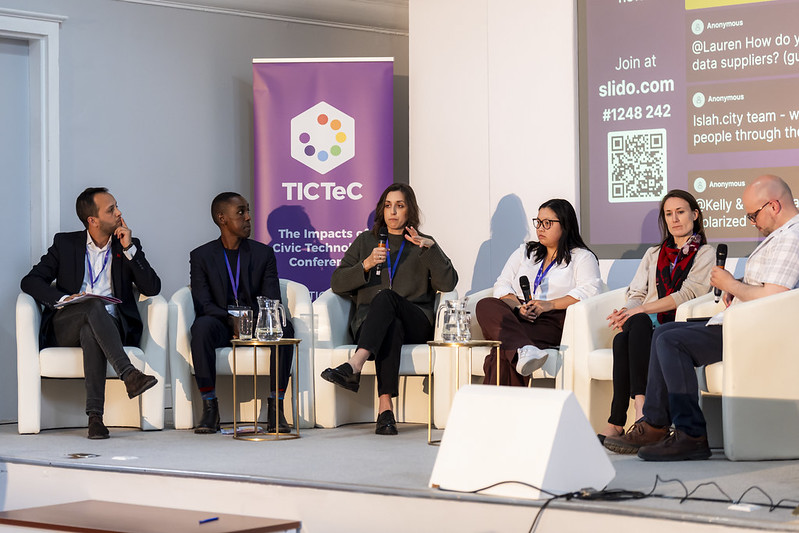
Abdellatif Belmkadem (left) and Maurice Sayinzoga (second-from-left) participate in a panel discussion about how civic technology can help to create feedback loops between citizens and government to improve service delivery.

In the heart of London, the TICTeC conference – held June 12 and 13 – was a rare opportunity to take a break from the grind and reflect on the amazing and inspiring work of civic technologists around the world. Hosted by MySociety and supported by the National Endowment for Democracy, this event was the first time the conference was held in-person since the COVID-19 pandemic forced most such convenings online. Representatives from the global civic technology community forged new relationships, shared tools for democratic engagement, and explored how emerging technologies are reshaping the civic technology landscape. 

NDI’s participation reflects our commitment to a critical message: democracy doesn’t end at the ballot box. Civic technologists play a particularly important role in supporting government service delivery and reinforcing feedback loops between government and citizens. For example, Code for Pakistan’s use of Ushahidi to help the government more effectively allocate aid after floods was a critical and timely application of open-source technology that directly impacted people’s lives. Since Ushahidi is open-source, the Code for Pakistan team was also able to develop a connection to the popular WhatsApp messaging tool, broadening the reach of the initiative. In another example, Abdellatif Belmkadem of the National Institute of Innovation and Advanced Technology of Morocco explained how using Fix My Street in Casablanca is not just facilitating infrastructure repairs, but fundamentally reshaping the social contract between government and citizens. This project is also furthering the development of the Fix My Street open-source project by exploring machine-learning based approaches to categorizing issue reports. The session, co-led by NDI’s Maurice Sayinzoga, DemTech Program Director, underscored that technology alone will not “make democracy work” and shared practical steps for engaging government stakeholders, navigating bureaucratic hurdles, and demonstrating the tangible benefits of technology tools. These examples demonstrate how technology can connect citizens’ needs with government action, but in both cases government buy-in is essential to ensure the tools actually help solve real-world issues, rather than just contributing to a backlog of unresolved complaints.

NDI also showcased innovative approaches to civic tech in closed and conflict affected contexts. Sarah Moulton, NDI Deputy Director for Technology and Democracy, moderated a panel discussion with Jesper Frant, NDI Senior Technology Project Manager, and representatives from two of NDI’s civic technology partners, Pavel Liber and Isabel Hou. The discussion centered on how tech tools can help to build community around democratic principles, despite seemingly insurmountable headwinds. Pavel shared his experience building an innovative online platform, New Belarus, that enables Belarusians to build a free Belarusian community online. Isabel shared her decades-long experience growing an active civic technology community in Taiwan. g0v holds weekly hackathons and develops tools to, among other things, protect the integrity of online information, and visualize government budget data. They recently completed a “Civic Tech Project & Community Handbook” which describes their approach to building community around civic technology. Jesper shared lessons learned for working with civic technology in countries with weak digital infrastructure, low tech literacy, and high security risk, emphasizing a human-centered approach and a commitment to “do no harm.” 

While the challenges in many of these contexts can often seem insurmountable, civic technology is about empowering citizens and enhancing the mechanisms of democracy. It’s about ensuring that every voice is heard and that governments are responsive to their citizens. NDI is committed to harnessing the potential of civic tech to make democracy more dynamic, participatory and effective.

This post was originally posted to the dem.tools blog.

Democracy Games for Democracy Gains: How DemTech uses games for good to support democracy programs

A photo from the main page of the Digital Organizing SOS: Stories of Security game shows the leaders of civil society organizations that you, as a digital security trainer, are asked to help as part of the game.

NDI’s Democracy and Technology (DemTech) team has a long history of experimenting with different types of games for good. We have even tried our hand at developing our own gaming platforms with varying levels of success.

For example, the defunct DemGames Debate app was a Drupal-based app intended to reinforce learning through fun practice quizzes. Originally designed to gamify NDI’s youth debates programs, it became evident that there was not sufficient demand to justify the expense of maintaining the platform and it was deprecated. 

DemTech’s more recent efforts to gamify learning have favored the narrative fiction style. Narrative fiction games are online games that use narrative storytelling to guide players through fun fictitious scenarios where they can choose their own adventure. These games are pretty simple to develop, and there are a variety of options of tools that can be used to build them. DemTech has experimented with Google Forms and Powerpoint, but has favored the more broadly-adopted open-source narrative fiction tool called Twine. Besides having a more rich, user-friendly, and flexible game development framework, Twine games are also simple HTML files that can be hosted at almost no cost and there is no need for software patches or updates for the game to live on indefinitely. So far, DemTech has created four Twine games:

  • Alissa for Olania! – ​​In this cybersecurity game, players take on the role of first-time presidential hopeful Alissa Orme’s campaign manager in the fictional country of Olania. They have to boost Alissa’s popularity and raise funds to help her win the election, while preventing cybersecurity incidents from derailing the campaign. (related blog post)
  • Digital Organizing SOS: Stories of Security – You play the role of a cybersecurity trainer to help leaders of civil society organizations more safely and effectively organize virtual workshops, fundraise online, use social media, and collect and store data. 
  • Human Centered Design – In this game, players take on the role of program lead tasked with designing a transparency and communication app. They have to test their knowledge of how to apply the principles of Human Centered Design effectively.
  • Leading Change – In this game, players are a youth leader seeking to boost the voices and needs of young people in a city’s COVID pandemic response. They have to learn about Adaptive Leadership, while exploring how this concept could play out in a realistic scenario.

NDI has also experimented with offline tabletop exercises (TTX). TTX are discussion-based sessions in which players are grouped into teams, assigned roles in a fictitious scenario, and called on to solve a series of challenges. These games give players a sense of what it’s like to work as a team to confront a realistic scenario, like a natural disaster or cybersecurity incident. 

DemTech developed a TTX game called CyberSim that simulates risks for a political party in a campaign environment and helps players assess their readiness and implement better digital security practices. To mirror the chaos of a typical campaign environment, the events of the game are rapid-fire and overwhelming. The immersive experience not only teaches lessons about cybersecurity, but also gives players a better sense of the high-stress and high-stakes environment in which decisions about cybersecurity incidents are often made.

Because the game is so rapid-fire, the pace can make the job of the facilitator difficult. To address this tension between creating a realistic–yet still functional–gameplay environment, DemTech developed an app to help CyberSim facilitators manage events and provide a summary of the actions taken. Crucially, the app enables facilitators to moderate an after-action review – a “post-game” exercise that allows players to reflect on what they learned. While originally designed to be played in person, DemTech recently developed an online version of the TTX that can be played using the Discord app. The team is also actively developing new versions of CyberSim tailored to civil society organizations and parliaments to join the current campaign-focused iteration.

Games for good are an innovative and effective way to educate, empower, and inspire people to take action on issues that matter to them. Whether it is online or offline, narrative fiction or tabletop exercise, games can create immersive and interactive experiences that challenge players to think critically, collaborate with others, and learn from their mistakes. DemTech has experimented with implementing “serious games” in various contexts and regions, with a focus on democracy, governance, and human rights. We invite you to explore our games, share your feedback, and join us in creating more games for good in the future. Together, we can make learning fun and meaningful. If you are interested in learning more about our games for good or playing them yourself, please visit our website or contact us.

This blog was originally published on dem.tools.

How DemTech Supports Digital Organizing Around the World

DALL-E generated image of a women sitting at a desk doing a water color in front of her computer.

Digital organizing is a key component of any successful political campaign. It involves using technology to mobilize supporters, raise funds, communicate messages, and get out the vote. It can also be a powerful tool for governing. Digital tools enable members of parliament to manage constituent correspondence or even manage interactions with citizens. However, not all digital organizing tools are created equal. Some are tailored to specific contexts, while others are better suited to business or sales applications.

That’s why the National Democratic Institute’s (NDI) Democracy for Technology (DemTech) team, decided to invest in developing and supporting the open-source platform CiviCRM. CiviCRM is a constituent relationship management (CRM) system that can be used to conduct many democracy activities, including conducting surveys and running campaigns, as well as basic CRM activities like managing contacts and sending emails. CiviCRM is a good fit for our partners that don’t have a lot of money to spend on digital campaigning tools, which is most of them. For partners with little experience with digital organizing, CiviCRM also provides a hands-on opportunity to introduce the concept. Partners who complete the training have the option to continue to use CiviCRM at no cost through DemTech’s DemCloud hosting service. They can also migrate their CiviCRM site off DemCloud to their own hosting environment, decide to use another CRM solution or simply choose not to use a CRM system at all.

For DemTech, one of the biggest advantages of CiviCRM is that it can be easily localized to a new country. It has been translated into dozens of languages, including Catalan, Dutch, French, Japanese, Polish, Portuguese, Serbian, Spanish, and Turkish. Not only can our partners use the tool in their own language, but they can adapt it to their specific needs and challenges. For example, CiviCampaign is a component of CiviCRM that allows users to create and manage advocacy campaigns, and it can be tailored to suit different electoral systems, voter registration processes, and campaign strategies.

DemTech has supported the use of CiviCRM across a wide variety of contexts. For example, a group of organizations in Democratic Republic of Congo (DRC) used Civi to survey key target audiences about their policy priorities as they prepared to launch broad advocacy campaigns in the runup to 2023 elections. 

DemTech also maintains relationships with technology vendors that specialize in supporting the tool such as iXiam and CoopSymbiotic

CiviCRM is not always the right digital organizing tool. NDI looks at a wide array of tools available such as MailChimp, NGP VAN, NationBuilder and Salesforce, and makes recommendations based on the ease of localization of the tool, how the tool has been used by democratic organizations, ease of use and cost. We are always exploring new contact management tools or opportunities to partner with companies that support digital organizing.

DemTech’s mission is to provide tailored support and advice on topics related to the impacts of technology on democracy, the use of technology in democratic development, and applying human-centered design approaches to democracy programming. We believe that digital organizing is a powerful way to empower citizens and strengthen democracy around the world. That’s why we support CiviCRM and other contact management tools that can help our partners achieve their goals.

This blog was originally posted on dem.tools.

Defeating Zoom Fatigue with Open edX

A pen drawing of a woman sitting at a computer looking tired.

Editor’s Note: This post was co-authored with Caitlyn Ramsey and edited with Microsoft Bing Chat.

It’s September 28, 2020 and COVID deaths have just surpassed one million worldwide. And as you watch the news, your boss sends you an email. You’ve been stuck inside for months watching the pandemic, political unrest, and natural disasters unfold with little to no interaction with anyone outside your bubble, and you’re expected to keep working as normal. And as all of your activities, including work, were forced online, you find yourself realizing something you never would’ve imagined: you are fed up with the internet. You have, as it turns out, a severe case of Zoom fatigue.

Zoom Fatigue has been an unexpected side effect of the pandemic. Individuals are experiencing exhaustion and burnout due to the excessive use of video conferencing calls. To address this issue, innovative platforms are being utilized by promoting engaging interactions and enhancing the overall experience of remote learning and communication. One such platform is Open edX, an open-source learning management system, which supplies a ready-built framework for mitigating Zoom fatigue for programs that deliver training online. Instead of relying solely on video conferences, Open edX enables engaging educational methodologies designed for the internet. Since its founding in 2012, OpenEdX has been used by a wide range of organizations, from institutions of higher education to major corporations, and even national governments. The platform uses a combination of video lectures, interactive exercises, quizzes, and other tools to deliver course content. The open-source nature of Open edX means that anyone can access and use the software, and modify and improve it as needed, without software licenses or subscription costs.

While the pandemic has abated in most regions (or at least been accepted as the new normal), the pre-pandemic “business as usual” where programming is delivered almost exclusively in-person has shifted permanently. In the post-pandemic world, there is a greater reliance on online training as in-person events are not always feasible and are more expensive. Moreover, air travel is a large contributor to climate change putting pressure on organizations to rethink the sustainability of programming that requires frequent international travel. This shift toward convening online has also contributed to the rise in Zoom fatigue as programs attempted to move their programs out of meeting rooms and into Zoom meetings, without fundamentally rethinking program delivery or design. 

Well before the pandemic, NDI hosted its own instance of Open edX (ed.ndi.org) to offer a wide range of courses aimed at strengthening democratic institutions and promoting citizen participation. These courses cover various topics such as cybersecurity for democracy activists, combatting information manipulation, digital rights advocacy, and best practices for leveraging technology to support democratic development. Some of the courses are self-paced and can be accessed anytime, while others are delivered through virtual classrooms accompanied by live instructors. Additionally, NDI offers customized training programs tailored to specific organizations and contexts. The courses are designed for individuals and groups interested in enhancing their knowledge and skills to effectively engage in democratic processes and advance democratic values.

Recent adopters of Open edX at NDI have used it to turn toolkits or guides, that would historically have been published in PDF format, into engaging multimedia online courses with integrated features that track learner progress and evaluate learning outcomes. 

Edx courses enable engaging online approaches that yield real learning. This, we’ve found, is something that even the most expertly-facilitated Zoom call cannot provide. Courses can have videos, slide shows, text, audio, live broadcasts, or a range of other methods of sharing information. The platform also can facilitate quizzes and evaluations, provide discussion boards and interactive games, and even integrate surveys for post-class feedback. Many people value the credentials that can come with education so NDI worked to improve the open-source OpenEdX software to provide elegant certificates personalized with their information for those who successfully completed a course.

Interest in the online learning platform has recently spiked. Ironically, just as the pandemic is easing, new programs are coming online that are making online methodologies for program delivery central to their approach. This includes the House Democracy Partnership – an initiative of the U.S. Congress supported by the National Democratic Institute and International Republican Institute – which is turning their Legislative Oversight Guide into a series of mini-courses, and NDI’s Movement-Based Parties initiative which is using Open edX to deliver engaging online training at scale.

These new online courses are a positive sign that NDI is moving beyond attempting to deliver via Zoom programs designed to be done in-person. Almost any program that has some educational component can emulate this approach and consider using Open edX to improve their program delivery and learning outcomes. Exceptions may exist in cases where intended learners have high security risk or do not have access to quality internet connections. Any online approach could further the marginalization of groups with limited or no access to the internet. If you’re interested in exploring the possibilities of Open edX for your own programs or want to learn more about NDI’s use of the platform, I encourage you to visit ed.ndi.org to see what courses NDI is currently offering and try Open edX for yourself.

This blog was originally posted on dem.tools.